PageCub Blog
Choosing the Right Lesson for a Personalized Children's Story
August 16, 2026
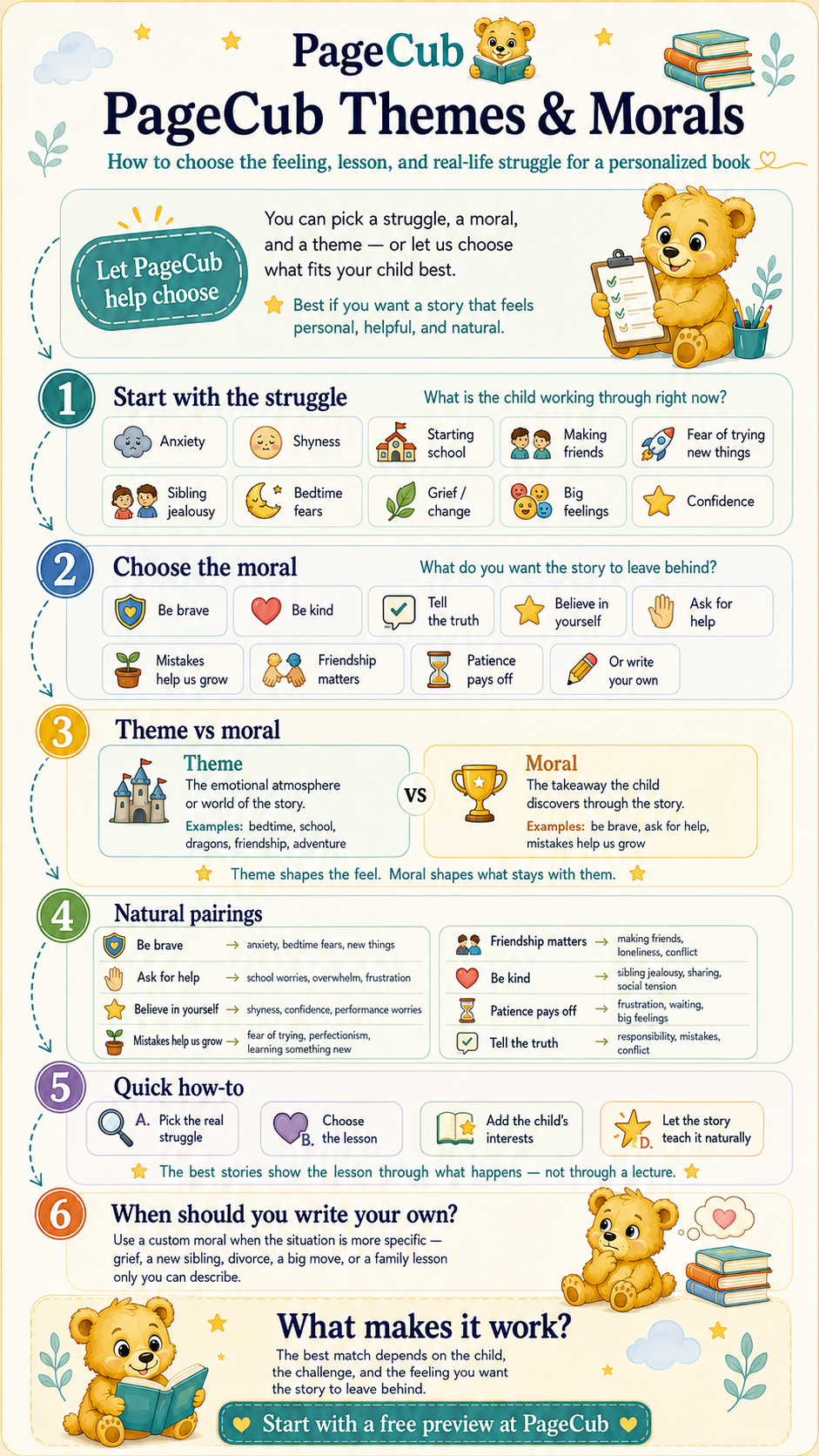
A children's story can be about dragons, school, a lost puppy, a moon base, or a monster under the bed.
But underneath the adventure, it may be carrying something else.
Be brave. Tell the truth. Ask for help. Try again. Be patient. Believe in yourself.
Those ideas are often called the moral of the story. And in a personalized book, choosing the right one matters more than it may seem.
The best lesson is usually not the one that sounds nicest. It is the one that fits the child and the problem they are actually facing.
Moral and theme are not the same thing
They overlap, but they do different jobs.
A theme is the emotional or imaginative territory of the story. Adventure. Friendship. Dinosaurs. Magic. Space. Mystery.
A moral is what the character discovers through what happens. Be brave. Ask for help. Mistakes help us grow. Friendship matters.
The theme is what the story feels like.
The moral is what the story leaves behind.
A child who is nervous about starting school might love dinosaurs. The dinosaurs can become the theme. But the lesson might be: Believe in yourself. Or: Ask for help. Or: Be brave. The same interest can carry very different lessons depending on what the child needs from the story.
Start with the struggle, not the moral
It can be tempting to begin with a virtue. “I want a story about kindness.” Sometimes that is exactly right. But if you are making the story for a particular child, another useful question is: What are they having trouble with right now?
Maybe they are anxious. Maybe they are shy. Maybe they are starting school. Maybe making friends is difficult. Maybe they refuse to try anything they are not immediately good at. Maybe a new sibling has arrived. Maybe bedtime has become frightening. Maybe something important has changed.
Once you know the struggle, the moral becomes easier to choose.
Anxiety can pair naturally with bravery
A story about anxiety does not need to end with the character becoming fearless. That is often less believable anyway. A better story may let the hero remain nervous and discover that they can still move forward.
That is a different definition of bravery. Not: I stopped being afraid. But: I was afraid, and I did it anyway.
That makes Be brave a natural choice for stories about anxiety, bedtime fears, starting school, or trying something unfamiliar.
Shyness may need confidence — or friendship
A shy child does not necessarily need a story telling them to become outgoing. Sometimes the more useful lesson is Believe in yourself. Sometimes Friendship matters. Sometimes Ask for help.
One child may want to make friends but fear rejection. Another may prefer quieter interactions. Another may need reassurance that one good friend is enough. That is why the moral should fit the actual child rather than the label.
Starting school has more than one possible lesson
A child worried about being away from a parent may benefit from Be brave. A child afraid they will not know what to do may fit Ask for help. A child convinced everyone else will already know everything might need Mistakes help us grow. A child worried about meeting other children may fit Friendship matters. The situation is the same. The story can still be completely different.
Fear of trying new things pairs well with mistakes
Some children avoid unfamiliar things because unfamiliar things might go badly. In that kind of story, Mistakes help us grow can work better than simply telling the child to be confident. The character can try, fail, try differently, fail in a new and possibly funny way, learn something, and eventually improve. The lesson does not have to be explained because the plot has already demonstrated it.
Sibling jealousy is often really about belonging
A new baby can create a complicated emotional problem. A story about sibling jealousy could carry Be kind. But it could also carry Patience pays off, or something custom such as: Love does not get smaller when it is shared. The strongest lesson is the one that gets closer to the emotional problem underneath the behavior.
Big feelings do not always need a moral about being calm
Anger, sadness, jealousy, disappointment, and frustration are not necessarily problems to eliminate. A story about emotions works best when the lesson respects the feeling rather than simply declaring it undesirable. A character can learn to say what they are feeling, or discover that a bad feeling can pass without the whole day being ruined.
Grief and change may need a custom lesson
Some situations do not fit neatly into a preset moral. “Be brave” may technically apply to grief, but it can feel strangely small beside the actual experience. A better lesson might be: Missing someone is one way of remembering how much they mattered. Or: It is okay to feel sad and still have good days. This is where writing your own moral becomes useful.
The story should carry the lesson
There is an easy way to ruin a perfectly good moral. Have a character announce it.
“And that is why, Oliver, you should always remember that patience pays off.”
Children can detect a lecture wearing a costume. A better story lets the lesson happen. If the moral is Patience pays off, the character might repeatedly rush, rushing creates problems, waiting becomes difficult — and eventually the character slows down and solves the problem because they were finally patient enough to see it. Nobody needs to explain the lesson. The child already watched it work.
The character should struggle before they learn
Lessons become believable when the opposite choice is tempting. A story about honesty is not especially meaningful if telling the truth is effortless. A better version gives the character a real reason to hide what happened. Now Tell the truth means something. The lesson matters because the character could have chosen something else.
Natural pairings
There are no fixed rules, but some morals naturally fit certain struggles.
Be brave
Anxiety · Bedtime fears · Starting school · New situations · Fear of trying
Be kind
Sibling conflict · Friendship problems · Sharing · Jealousy
Tell the truth
Hiding mistakes · Fear of consequences · Friendship conflict · Taking responsibility
Believe in yourself
Shyness · Confidence · Performance anxiety · Trying something difficult
Ask for help
School anxiety · Frustration · Feeling overwhelmed · Trying to solve everything alone
Mistakes help us grow
Perfectionism · Fear of trying · Learning new skills · Low confidence after failure
Friendship matters
Making friends · Loneliness · Conflict · Cooperation · Seeing another person's perspective
Patience pays off
Frustration · Waiting · Sibling conflict · Learning something difficult
These pairings are starting points. They are not diagnoses. Two children can struggle with the same thing and need completely different stories.
Sometimes the obvious moral is not the best one
Imagine a child who is anxious about making friends. The obvious moral might be Friendship matters. But perhaps the actual problem is that they are afraid to introduce themselves — then Be brave may fit better. Or maybe they assume nobody will like them — then Believe in yourself may be stronger. The struggle tells you where the story begins. The moral tells you what kind of change you want the character to experience.
When should you write your own?
Use one of the preset morals when it says what you mean — they are intentionally broad. Write your own when the lesson is more specific to the child or situation. Maybe you want: Being different can be a strength. Or: There is enough love for everyone. Or: You can miss someone and still keep going. If you already know the sentence you hope the child carries away, use it.
You do not need to solve the problem in one book
A children's story can open a door. It does not need to finish the entire conversation. A book about starting school will not remove every first-day worry. The goal is smaller: give the child another way to look at the problem, let them watch someone like themselves encounter it, let them imagine another response. Sometimes that is enough for one bedtime story to do.
Choosing the moral in PageCub
When you create a book, you can choose from several common lessons — or write your own. You can also tell PageCub what the child is currently dealing with. Those two choices work together: the struggle tells us what the character is facing, the moral tells us what you hope they discover along the way, and the adventure is what connects them.
When it works, the child does not finish the book thinking: I have received an important moral lesson. They finish thinking about the hero. And somewhere inside all of that, the lesson has already landed.