PageCub Blog
What Story Shape Fits Your Child Best?
August 16, 2026
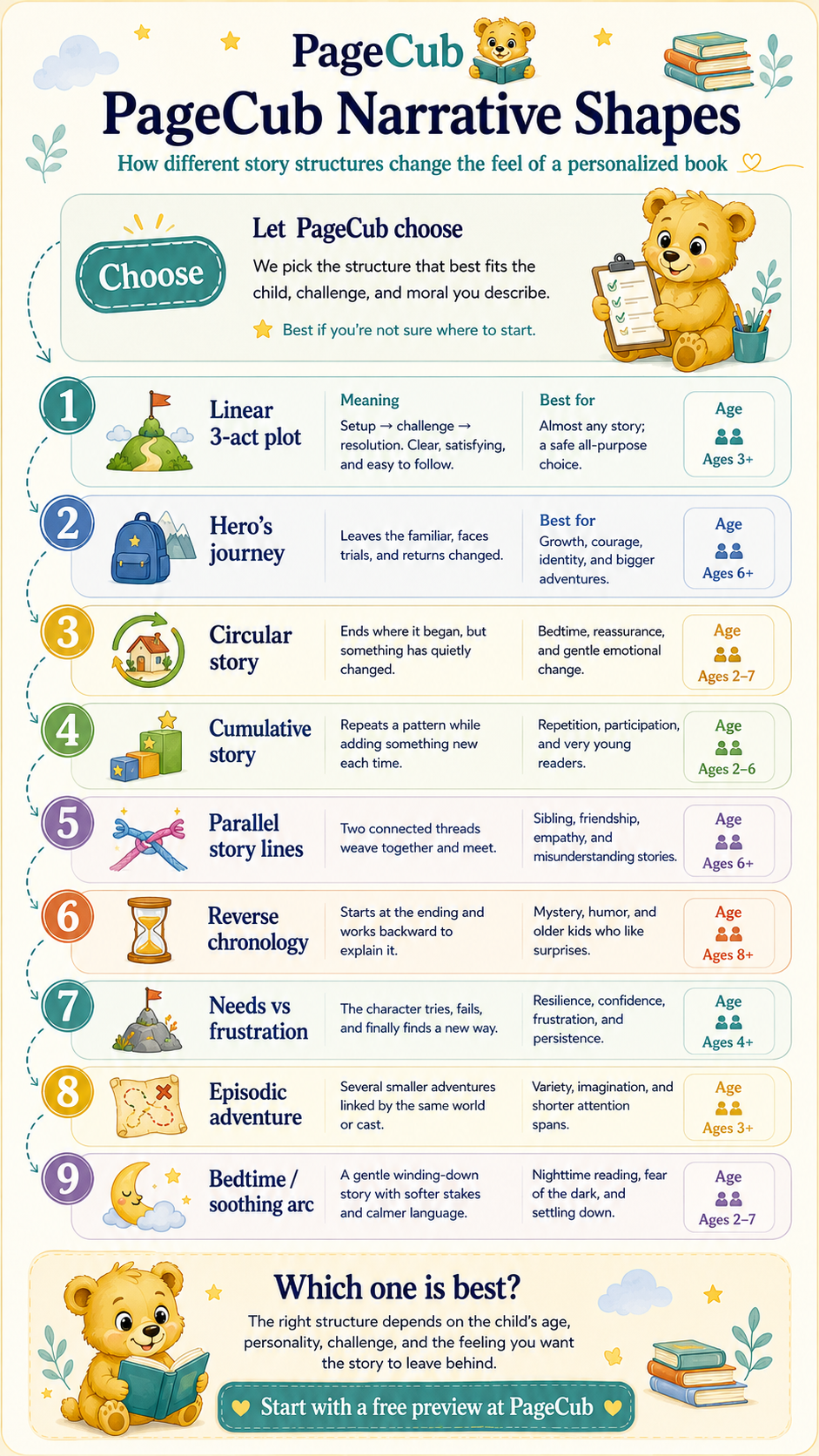
Most people think about a children's story in terms of what happens.
A dragon appears. Someone gets lost. A child starts school. A monster turns out not to be very scary.
But stories also have a shape.
That shape changes how the story feels.
Some stories move in a straight line toward a clear ending. Some repeat and build. Some wander through several smaller adventures. Some begin at the end and make the reader work backward. Some return almost exactly to where they started, except the child has changed along the way.
None of these shapes is automatically better than another.
The useful question is: What kind of story best fits this child, this age, and this particular problem?
PageCub can choose a narrative shape automatically, or you can select one yourself. Here is what each one does.
Shape 1
Linear Three-Act Plot
This is the familiar shape most people picture when they think of a story.
Something is normal. Then something changes. The character faces a problem. Eventually, they solve it.
A child might be nervous about starting school, meet a challenge on the way, struggle with it for several chapters, and eventually discover that they can handle more than they expected.
It works because it is easy to understand. Even very young children intuitively recognize the pattern: beginning → trouble → solution.
Why it works
The structure is clear. There is usually one central problem, so the story does not ask the reader to keep track of too many moving pieces. It also works well when a story has a lesson underneath it because the lesson can emerge directly from solving the problem.
The tradeoff
Three-act stories are reliable partly because they are familiar. That can also make them feel predictable. For a child who likes unusual stories, mysteries, or repetition, another shape may create something more interesting.
Good uses
Starting school · Fear of the dark · Learning to share · Confidence · Trying something new · Adventure · Almost any first PageCub book
Shape 2
Hero's Journey
The hero's journey is related to the three-act structure, but it tends to feel bigger. The character begins in a familiar world. Something calls them away from it. They enter unfamiliar territory, meet helpers and obstacles, face increasingly difficult trials, and eventually return changed.
The important part is the return. The child does not simply solve a problem. They become slightly different because they solved it.
How it differs from a three-act story
A three-act story is mostly about solving the problem. A hero's journey is more explicitly about how the journey changes the hero. The two can overlap, but the emphasis is different.
The tradeoff
It tends to be more complicated. There are often more stages, more locations, and more emotional movement. That can be wonderful for older children and sometimes a little much for very young readers who mainly want to know whether the bear found his blanket.
Shape 3
Circular Story
A circular story ends somewhere very close to where it began. The child may leave their bedroom, travel through an enormous imaginary world, solve a problem, and eventually return to the same bed. But now something is different.
Maybe the room feels less frightening. Maybe the child understands something they did not before. The setting comes full circle. The character does not.
Why it works
Circular stories create a sense of completion. That makes them especially satisfying at bedtime. They can also be reassuring for younger children because the story eventually returns to something familiar.
Good uses
Fear of the dark · Bedtime anxiety · Separation · Homesickness · Stories about returning home
Shape 4
Cumulative Story
A cumulative story repeats something familiar while adding a new piece each time. Children often catch onto the pattern before the adult reading the story finishes it. That is part of the fun.
Why repetition works
Young children learn through repetition constantly. They also enjoy being able to predict what comes next. Once they recognize the pattern, they stop being only listeners. They become participants — they can finish the phrase, remember the next creature, guess what gets added.
Good uses
Counting · Routines · Bedtime · Funny adventures · Very young readers · Books meant to be read aloud repeatedly
Shape 5
Parallel Story Lines
Parallel stories follow two characters or two connected events at the same time. The reader moves back and forth between them until the two threads finally meet.
Why it works
This structure is unusually good for showing that two people can experience the same situation differently. It can help a child see that another character is not necessarily bad simply because they wanted something different.
Good uses
Siblings · Friendship · Misunderstandings · Conflict · Jealousy · Cooperation · Empathy
Shape 6
Reverse Chronology
A reverse-chronology story begins near the ending. Something strange has already happened — the castle is upside down, the birthday cake is on the roof, everyone is covered in blue paint. The reader's first question is: How did this happen? The story then works backward.
Why it works
It immediately creates curiosity. Instead of wondering what will happen next, the reader wonders what happened before. It needs to be written carefully so the reveals feel satisfying rather than simply confusing.
Shape 7
Needs vs. Frustration
The character wants or needs something. They try the obvious solution. It fails. So they try again. That fails too. The frustration builds until they finally realize that the problem requires a different approach.
The important moment is not simply success. It is the change in strategy.
Why it works
This structure mirrors something children experience constantly. Trying harder does not always work. Sometimes they need to ask for help, slow down, try differently, or stop avoiding the thing they fear.
Good uses
Anxiety · Confidence · Perfectionism · Frustration · Learning a new skill · Fear of failure · Persistence
Shape 8
Episodic Adventure
An episodic story is less like one long problem and more like a series of smaller adventures. Each chapter has its own little beginning, problem, and ending. The episodes connect through the same characters, world, or larger goal, but each one can stand mostly on its own.
Why it works
This structure is forgiving. If a child loses focus for a chapter, they can often rejoin the story easily. It also gives the book frequent novelty — useful for children who love characters and worlds but do not yet have much patience for one long developing plot.
Shape 9
Bedtime / Soothing Arc
Some stories are supposed to make children lean forward. Others are supposed to help them settle back into the pillow. A bedtime arc is built around that second goal.
The stakes stay manageable. The language becomes calmer. Scenes gradually become quieter rather than escalating toward a giant climax. A highly exciting story about a screaming dragon chasing everyone through a volcano may be excellent. It may also be a poor strategic choice at 8:17 p.m.
Good uses
Bedtime fears · Fear of the dark · Separation at night · Sleeping alone · Stories intended to become part of a bedtime ritual
Age matters, but not as much as the child
The age ranges above are only guidelines. A five-year-old who adores complicated stories may enjoy a hero's journey. A nine-year-old may love a cumulative story if it is absurd enough. Some children want plot. Some want repetition. Some want to revisit the same comfortable pattern every night for three straight weeks.
The lesson matters too
Different story shapes naturally support different kinds of lessons.
A story about perseverance fits beautifully into a needs-versus-frustration structure. A sibling disagreement may work better with parallel story lines. Fear of the dark may fit a circular or soothing bedtime arc. A story about independence may belong naturally in a hero's journey.
This is why PageCub does not treat story structure as decoration. The shape changes how the lesson reaches the child.
So which one should you choose?
If one immediately sounds right, choose it.
If your child loves repetition, try cumulative. If they are going through a big change, a hero's journey may give that change more weight. If bedtime is the problem, a circular or soothing arc may fit better. If siblings or friends are seeing the same situation differently, parallel story lines can make that visible.
And if you do not know, that is completely fine. Choose Let PageCub decide. We can look at the child's age, personality, interests, the challenge you described, and the lesson you want the story to carry, then select the structure that fits those pieces best.
Because the point is not to choose the cleverest story shape. It is to choose the one that makes this particular story work.